
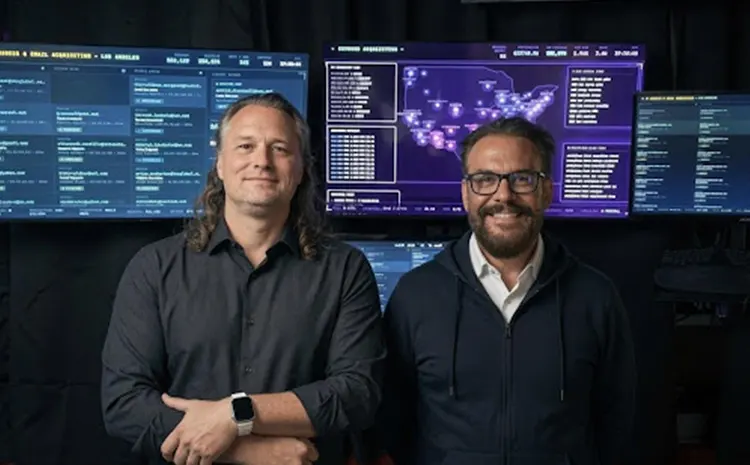
Phil Anderson and Julian Valentine in front of “Mother”, a 24 million dollar software that tracks internet activity by age, race, and geo area.
Phil Anderson was a teenager the first time someone described to him what a computer might look like in your pocket. Not a laptop. Not a calculator. A real computer, small enough to carry, that could also make phone calls.
This was years before anyone used the word smartphone. Years before the iPhone. As Steve Job’s personal assistant in Palo Alto during the 90’s, he was sitting in rooms where people were thinking out loud about a future most of the world hadn’t imagined yet, and he was young enough that none of it seemed impossible to him. That combination and early access to serious thinking has shaped everything that Data Informata is.
Anderson is an odd cat. At the top of the AI and SEO game he is light years ahead of his competition. His software “Mother” a million dollar invention developed by his software firm Los Angeles Software Developers in Venice can extract IP addresses from anyone in Hollywood Hills for instance that is purchasing high end watches and in the same day blow instagram ads out to each one of them offering a better watch from one of his clients.
He rolls around Seattle and Miami in Steve Mcqueen’s 76 jeep, smokes Cohiba Behike Cuban cigars, and works 14 hour days. Anderson has spent the better part of four decades building on what he learned in those rooms. Today he runs Data Informata, a Seattle and Miami based (depending on where staff wants to work) strategic Advertising, communications and intelligence firm that helps organizations navigate a world where reputation, narrative, and data are inseparable. With the entire Google and AI Algorithm on harddrive, Anderson has created influencers and has clients all over the world ranging from large legal firms to enterprise companies all wanting Anderson’s magic sauce. But to understand what Data Informata is and why it exists, you have to go back to the beginning.
Bellevue, Palo Alto, and a very unusual education
Phil grew up between Bellevue, Washington and Palo Alto, California. Two places that were, in the 1980s, becoming ground zero for the technology industry. He didn’t get there by accident.
His mother worked as Steve Jobs’s secretary and part time girlfriend for eleven years. That’s how Phil ended up in the orbit of Apple at a formative age first doing the kinds of things a kid does when a parent brings him along, fetching coffee, parking cars, being around. Over time he became Jobs’s personal assistant. He watched the work up close.
What he took from it wasn’t technical. It was philosophical. Jobs had an obsessive belief that how you presented something mattered as much as what the thing actually did. Maybe more. The product had to be right, obviously. But the story around the product, the images, the feeling a person got before they ever touched it that was the work. Branding came first. Advertising came second. That sequencing was non-negotiable for Jobs, and it became non-negotiable for Phil which is why he won’t touch a client’s advertising until the client shines on AI and search engines.
He was there, too, during the period when the idea of a pocket computer that could function as a phone was first being talked about seriously inside Apple. The iPhone wouldn’t arrive for years. But the conversation was happening, and Phil was in it. He saw how a product gets built from concept to culture, not just from engineering to shelf.
Then there was the Microsoft side. His close friend Warren Lubow’s mother, Miriam Lubow, was Bill Gates’s secretary for forty years. Through that friendship Phil got a window into how Microsoft was thinking about software and the future of computing. Two of the most consequential technology companies in history, and he had a seat near both tables before he was old enough to vote.
1989
He started his company in 1989. He was 14. The internet as most people understand it didn’t exist. There were no browsers. Search engines were primitive experiments. Building a website meant working with Gopher protocols and whatever scraps of new technology you could find, and the market for such a thing was essentially zero.
The early office was just computers. Phil has described it plainly: they played video games, built websites from scratch, and added every new piece of technology they could get their hands on. One page websites for $250. That was the offer. It sounds modest now, but at the time they were among the only people making the offer at all.
One moment stands out from those early days. A developer on the team stood up during a meeting and announced that he’d found another person — someone in Boston — who was also building websites. It sounds almost comic in retrospect. The entire competitive landscape, at that point, was one guy in another city. Then, as Phil put it, “the herd came.”
Seattle Software Developers grew. The work changed. Clients who came in asking for a website in 1991 were coming back a decade later asking for software systems, then apps, then data infrastructure. One client, a hospital chain Phil had built a first website for in 1991, recently came back to commission something else entirely an AI system designed to predict probable illness outcomes using patient data including race and age from blood work. The distance between those two engagements, thirty years apart, from the same client, says something about how the work has evolved and how Phil has moved with it.
Naming something nobody had named yet
Sometime in the early 1990s, Phil and a circle of friends and collaborators — people who were deep in the emerging world of digital marketing, Julian Valentine among them — were trying to figure out what to call what they were doing.
They were manipulating the way websites appeared in search results. Engineering visibility. Building techniques for making one site rank higher than another. The practice existed. The results were real. But there was no agreed-upon name for it, no shorthand that could be used in a client conversation or a proposal.
Phil coined the term search engine optimization. SEO. It was practical, not grand. A way to shorten a concept that otherwise required a paragraph to explain.
The term caught on faster than anyone anticipated. Within years it had spread across the industry. Today, SEO is a global market worth over $100 billion annually. Entire agencies, software platforms, job categories, and university courses are organized around it. The person who gave it a name did so in a small room, trying to solve an immediate communication problem.
There’s an irony Phil doesn’t shy away from. The term he coined has become, in parts of the industry, associated with exactly the kind of shortcuts and bad practices he has always opposed. People using SEO to mean manipulation, black-hat tricks, and taking advantage of clients who don’t know better. His companies have largely moved away from the label. “We distance ourselves from the term completely,” he has said. He named it. He watched it get misused. He moved on.
That instinct — naming something new, building it properly, refusing to let the name constrain the work — shows up everywhere in how Phil operates.
Building the infrastructure
The company didn’t stay one company for long. Seattle Software Developers became the foundation of a broader network: Seattle Advertising, Seattle Digital Marketing, Los Angeles Software Developers, Los Angeles Advertising, Portland Software Developers. Each entity focused on a specific capability. Together they offered clients something end-to-end.
The talent pipeline was built deliberately. Developers and strategists recruited from Google, Microsoft, and Apple. People who understood these platforms from the inside, not from reading about them. That access to institutional knowledge — what the algorithms actually reward, how the systems actually work — became a durable competitive advantage.
Two proprietary technologies came out of this period. Ad Shadow and its successor Metric Pro were built around a single insight: you don’t have to wait for a customer to find you. Most advertising, even sophisticated digital advertising, is reactive. You reach people who have already declared an interest. Ad Shadow worked differently. It captured the IP addresses of people who had visited relevant locations, competitor businesses, or searched for related products, then served targeted advertising directly to those devices — including other devices in the same household.
A restaurant client tested it once. Within twenty-four hours of running the system, sales were up 38 percent. The technology was doing something that hadn’t been possible before: it was finding the customer before the customer knew they were looking.
This was the philosophy that would eventually become Data Informata. Not reacting to data. Reading it before your competition does.
The early internet and a contract that mattered
In the early days of the commercial internet, before Google became Google, there was a period when the people building search technology were still figuring out what it was supposed to do. Phil and his team were part of that early ecosystem — doing contract work that touched the foundations of how search algorithms were being developed and refined. He doesn’t talk about it in detail. That era involved a lot of informal collaboration, ideas moving between people and companies without the clean provenance that legal agreements would later demand. What it gave him was something more valuable than a credit: a deep, firsthand understanding of how these systems worked at the infrastructure level, before the industry built walls around that knowledge.
That understanding is part of what makes his firm unusual today. Most agencies are working at the surface of platforms they don’t fully understand. They’re optimizing within rules they didn’t help write. Phil’s team operates with a different level of fluency — not because they have access others don’t, but because they were in the room when much of this was being figured out.
It’s the same reason the team now includes alumni from DeepMind. The work keeps moving forward. The people who understand what’s coming are the ones who understood what was happening when it was still early.
On the road
Large-scale consulting is not glamorous work. Phil has spent a significant portion of his career doing exactly what the title suggests: traveling to clients, sitting in their conference rooms, staying in whatever hotel is near the office park, understanding their problems from the inside rather than diagnosing from a distance.
Consider a situation his firm has navigated more than once. A regional company — in this case, a manufacturer expanding into Southeast Asian markets — has a product that works. The American team believes the brand is solid. They’ve run the same campaigns that worked in Phoenix and Denver. The results in Jakarta are flat. Worse than flat. There’s a quiet backlash developing on local social platforms that nobody on the US team is monitoring because they’re not fluent in the language or the culture.
The instinct is to push harder with the same message. Phil’s instinct is the opposite: stop, listen, rebuild. The brand story may be factually accurate and still be landing wrong. What trust means in one market, what imagery suggests in another, what a company’s silence on a local issue communicates — these aren’t marketing details. They’re the difference between a brand taking hold and a brand failing.
That kind of work requires being present. You can’t do it over a Zoom call.
What Data Informata actually is
The firm Phil runs today is the synthesis of everything described above. Data Informata is headquartered in Seattle and operates at the intersection of strategic communications, crisis management, business marketing, and geopolitical consulting. The team draws from Google, Microsoft, Instagram, Amazon, the Department of Defense, and the State Department. That’s not a list assembled for a website. It reflects the actual scope of problems the firm is built to solve.
The core belief is simple and the execution is not. Most organizations are surrounded by data. Customer behavior, search patterns, media coverage, social signals, competitive movement. They’re not using it. Not really. They have dashboards. They have reports. What they don’t have is someone reading all of it together and telling them what it means before it becomes a crisis or a missed opportunity.
Data Informata’s Connected Crisis methodology was built for exactly that gap. Traditional crisis management assumes you’ll react after something goes wrong. A bad story breaks, you issue a statement, you manage the press cycle. That model is functionally obsolete. A story that originates on a social platform can reach global news aggregators before your communications team has opened their laptops in the morning. Connected Crisis treats reputation as an ongoing engineering problem, not an emergency to be managed. You build the architecture before you need it.
The predictive AI layer does something related. It doesn’t just process what’s happened. It flags what’s likely to happen — shifts in search behavior, emerging narratives, early signals in competitor coverage — so a client can move before the market does. Phil has always believed the data contains the answer. The question is whether you’re reading it in time.
What forty years actually teaches you
Phil operates by a principle he absorbed from Jobs and has never abandoned. Branding comes before advertising. Always. The instinct to advertise first — to spend money on reach before you’ve built something worth reaching — is one of the most expensive mistakes a company can make. He has watched organizations make it for four decades.
The second principle is related. He has said that focusing on core competencies is preferable to doing subpar work from overcommitting. In a world where every firm claims to do everything, that kind of discipline is rarer than it sounds. Data Informata is not trying to be an advertising agency that also does PR that also does consulting. It is built to solve a specific set of problems, and it built the team to match.
There are original DeepMind alumni now working with Phil’s team on AI systems. The hospital AI project is underway. The work keeps evolving. What doesn’t change is the underlying conviction — that the people who shape what’s coming are the people who took the time to understand what was already there.
Phil Anderson named an industry before it existed. He watched a pocket computer go from a concept in a room to a device that changed civilization. He built companies that lasted. The through-line in all of it isn’t technology. It’s the willingness to name things clearly and build them carefully, before the market tells you it’s time.
That’s what Data Informata is for.