
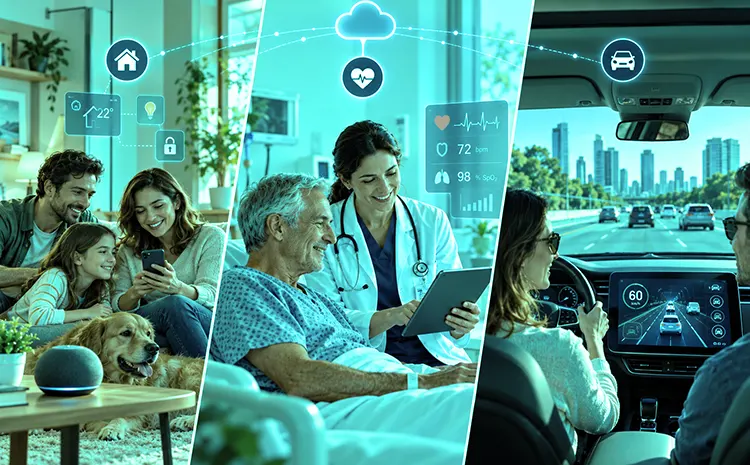
The Internet of Things (IoT) is a communication network to connect devices to the Internet so these devices can collect, analyse and process the data. Real-time IoT applications are connected devices that can react to and take actions on the data.
Drones and vehicle-to-X communications, also known as the Internet of Things (IoT), are now in use in several parts of our daily lives. It can be found in applications for smart homes and healthcare. Also, it can be found in connected vehicles. The applications can be used for automation, monitoring and the efficiency of connected services.
In this article, we will focus on some real-time IoT applications that common smart homes, smart cars, and hospitals use.
What Is the Internet of Things (IoT)?
The Internet of Things is a network of connected physical devices that can collect and exchange data.
These connected devices can generate data that is collected, processed, and analysed by IoT platforms. This information becomes relevant to the user because it allows for conclusions to be drawn about their habits and preferences, as well as making their life easier. For example, if there’s a problem with your car, you might receive a notification to take it to a repair shop.
IoT Examples and How It Is Used in Everyday Life
Today, the increasing number of connected objects is a fact that we can see in our daily lives. For example, a huge number of connected objects (IoT) are used in different fields, such as transportation, home automation, and everyday household tasks. Below are some examples to help you understand the impact of this:
- Autonomous vehicles: there’s increasing talk about cars that drive themselves without the user having to do anything other than tell them where they want to go. What’s clear is that vehicles are becoming increasingly intelligent, with touchscreens and a huge number of sensors that make life easier for the user.
- Robot vacuum cleaners: they have a large number of sensors that allow them to clean the floor of the house without bumping into anything and independently avoid obstacles.
- Smart home: “Smart” devices for homes include everything from presence sensors that automatically turn on lights to temperature or humidity sensors that activate other appliances. Even assistants like Alexa are IoT devices.
There are so many “things” and applications that this term has been called the “Internet of Things”; as we said before, it is an abstract entity that is difficult to define.
Also Read: Companies Are Increasingly Benefiting From IoT
What Are Real-Time IoT Applications?
We’re going to discuss real-time IoT applications. As we all know, the Internet of Things (IoT) is a widely discussed topic today and makes life easier.
There are so many IoT applications on the market, and their number is growing daily. IoT devices that connect our data to other devices are in high demand. These devices are often called smart devices, and they reduce human effort.
Smart Home IoT Applications
Smart home technology is one of the common applications of IoT devices. People generally like it a lot.
It involves the automatic control of household appliances to make human life easier and simpler.
So, what makes smart home devices so popular? It’s simply saving money, energy, and human effort. Like sitting in bed, we can just turn off the lights, ventilate, lock the door, make dinner, do laundry, clean the floor, and much more. Now, think about it. Isn’t that fantastic?
Now, many companies have expanded their operations by producing smart home devices. They sell a wide range of smart home products, as home automation has become their core business. Some of the best smart home devices are:
- Amazon Alexa: Can play music, make a phone call, set a reminder, tell the news, find nearby restaurants, get answers to your question, turn the light on and off, lock the door, and much more.
- Google Assistant: This gadget is a voice-controlled device. It features the Google Cast Plus voice assistant with Bluetooth and USB charging, a clock, multiple alarms, music playback, and smartphone and tablet control.
- Amazon Echo: can play music, make a phone call, set a reminder, tell the news, find nearby restaurants, get answers to your question, turn the light on and off, lock the door, and much more.
- Philips Hue bulbs: It provide a preset light need as required, stay connected, provides many shades of white light.
- Wink Hub 2: Add voice control by combining it with Alexa devices.
- Samsung SmartThings Hub: Connects smartphones and makes them work together. It has a light, speaker, thermostat, sensor, and more.
IoT in Healthcare
IoT technology has significant potential in connected healthcare services. It provides specialized care to patients. By asking questions, it can support patient monitoring, communication with healthcare professionals, and data collection.
Therefore, data collection aids in personalised analysis. In conclusion, IoT can support connected healthcare services and data-based care.
There are companies and apps like these that help people with connected healthcare. Read more about it.
Smart Cars and IoT
IoT has also brought about a major change in the characteristics of vehicles.
Similarly, connected vehicle technology is expanding as demand for connected services increases. Furthermore, connected or smart cars use dedicated short-range communications (DSRC).
However, some connected vehicles can support automated functions. Therefore, they have a self-maintenance function, automatic parking, and provide comfort to passengers.
As a result, the built-in car app allows anyone to find the nearest coffee shop or gas station.
They use the data network to carry vehicle navigation, diagnostics, weather, traffic reports, web browsing, etc.
| IoT Application | Main Use | Examples |
| Smart Home | Automates household tasks and connected devices | Smart lights, locks, thermostats, speakers |
| Healthcare | Supports patient monitoring, communication, and data collection | Connected health devices, patient monitoring systems |
| Smart Cars | Provides connected vehicle services and automated functions | Navigation, vehicle tracking, automatic parking |
The following are the benefits of smart cars:
- Vehicle tracking
- Driverless driving
- Integrated iOS and Android apps
- Revenue management
- Smart Wallet
- Automatic parking
- Automatic rate calculation
- language help
- IoT device for total control
- Traffic jam assistance
- Security assistance
Conclusion
IoT real-time applications are utilised for various application domains such as smart homes, healthcare systems and smart cars. Connected devices can automate various tasks, enable data gathering and monitoring, provide connected services, etc. As IoT development moves forward, the applications of IoT can lead to a more connected consumption experience of devices and services.
Also Read: 5 Top IoT App Development Trends To Watch